Updated: July 2026
Bandaneira vs Raja Ampat: Which is Indonesia's Ultimate Luxury Escape?
- Scale: Raja Ampat is a sprawling 40,000 sq km marine park; the Banda Islands are a compact, easily navigable cluster of eleven.
- Focus: Raja Ampat is a pure marine expedition; Bandaneira offers a rich mix of history, culture, and diving.
- Atmosphere: Raja Ampat is grand, adventurous, and on the global diving map; Bandaneira is discreet, atmospheric, and a connoisseur’s secret.
The air hangs thick and sweet, a heady perfume of drying cloves and nutmeg carried on the sea breeze. Below the surface, a mandarin fish performs its kaleidoscopic dusk ballet. This is the sensory immersion of the Banda Islands. Half a world away, yet in the same archipelago, the hornbill’s call echoes across a karst island labyrinth as a manta ray, wide as a grand piano, glides through a channel teeming with fusiliers. This is the raw, magnificent scale of Raja Ampat. For decades, the discerning traveler seeking Indonesia’s ultimate marine escape has faced this exquisite dilemma. It’s a question we at the Departures editorial desk have debated countless times over single-origin Sumatran coffee. This isn’t a simple choice between two destinations; it’s a choice between two philosophies of luxury travel.
The Arrival: A Tale of Two Journeys
The character of a destination reveals itself in the journey required to reach it. Getting to Raja Ampat is an exercise in logistical commitment, a multi-leg pilgrimage that filters out all but the most determined. The gateway is Sorong (SOQ), a functional port town in West Papua. Most travelers arrive after a four-hour flight from Jakarta (CGK) or a connection through Makassar (UPG). From Sorong’s small airport, you are whisked away, not to a hotel, but typically to a harbor where your vessel awaits. The transfer to a world-class phinisi like the Aqua Blu or a private speedboat for the 90-minute journey to a resort like Misool Eco Resort is seamless, yet it underscores the region’s remoteness. You are embarking on an expedition, and the journey itself sets a tone of grand adventure across a vast, watery frontier.
The approach to Bandaneira is an entirely different affair, one defined by intimacy and exclusivity. The journey also begins with a flight to a provincial capital, in this case, Ambon (AMQ). From there, the path diverges. While a public ferry exists, the luxury traveler opts for a more refined route. A private charter flight is the ultimate statement, a 50-minute hop that provides an astonishing aerial perspective of the tiny, volcanic Banda archipelago rising from the deep blue of the Banda Sea. Landing at the small airstrip on Banda Neira (NDA) feels less like arriving at a tourist hub and more like being welcomed into a private estate. The sense of arrival is not one of conquering distance, but of being granted access to a secret. This curated journey is a core tenet of the bandaneira luxury experience; it’s about removing the friction of travel to preserve the magic of discovery.
Under the Surface: A Diver’s Dilemma
Let’s be clear: the diving in both locations is superlative. But they offer profoundly different underwater narratives. Raja Ampat is the undisputed global epicenter of marine biodiversity. Located in the center of the Coral Triangle, its statistics are staggering. As noted by conservation groups and marine biologists, the region is home to over 1,600 species of fish and 75% of the world’s known coral species. Diving at sites like Cape Kri, which holds the world record for fish species counted on a single dive (374, to be exact), is an experience of overwhelming abundance. It’s a sensory overload of color and movement—schools of barracuda numbering in the thousands, oceanic mantas at cleaning stations, and the elusive wobbegong shark camouflaged on a reef. A week on a liveaboard here is a highlight reel of the planet’s most vibrant marine life. It is, without exaggeration, a pilgrimage site for serious divers.
Bandaneira’s underwater realm is no less spectacular, but it tells a more nuanced story. The marine life here is set against a dramatic backdrop of volcanic geology. At sites like Batu Kapal, you navigate immense pinnacles that rise from the abyssal depths of the Banda Sea, one of the deepest seas in Indonesia. The 1988 eruption of Gunung Api volcano covered the nearby lava flows with molten rock, and today, these flows are carpeted in some of the fastest-growing and most pristine hard coral gardens on Earth. It’s a testament to nature’s resilience. The diving here feels more exploratory. You can spend an hour with a school of thousands of red-toothed triggerfish off the coast of Pulau Hatta or watch the famed mandarin fish mating ritual right off the jetty of the Cita Resort at sunset. The defining difference is solitude. In Banda, it is not uncommon to have a world-class site entirely to yourself for days on end—a true luxury in today’s diving world.
Life on Land: Colonial Ghosts vs. Untouched Nature
Above the waterline, the two destinations diverge completely, and this is where Bandaneira presents its most compelling argument. Raja Ampat is a wilderness, a place where luxury is defined by its pristine nature and isolation. On-land activities are extensions of this natural immersion: arduous treks through dense jungle to witness the surreal courtship dance of the Red Bird-of-Paradise, climbing the 300-plus steps at Piaynemo for that iconic view over the karst islets, or visiting a local Papuan village to see a way of life intrinsically tied to the sea. The human footprint is minimal; the story is one of geology and biology, not history.
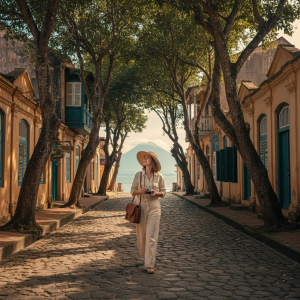
Bandaneira, however, is a living museum. To walk the quiet streets of Banda Neira town is to walk through the turbulent, avaricious history of the 17th-century spice trade. The air itself feels heavy with stories. Here, the Dutch Vereenigde Oost-Indische Compagnie (VOC) built a brutal monopoly on nutmeg and mace, spices once worth more than gold by weight. You can spend an afternoon exploring the commanding presence of Fort Belgica, a pentagonal fortress and UNESCO Tentative World Heritage site, that has dominated the harbor since 1611. You can have a private guide lead you through sprawling nutmeg plantations, still shaded by giant kenari trees, and visit the decaying but impossibly atmospheric Dutch colonial mansions (the *perkenhuizen*). This historical depth provides a cultural counterpoint to the natural beauty, creating a richer, more textured experience. It’s a place that engages the intellect as much as the senses.
The Accommodation: Phinisi Fleets and Historic Estates
The style of accommodation in each destination perfectly mirrors its core identity. In Raja Ampat, luxury is sea-based or island-isolated. The dominant choice is the phinisi, a traditional Indonesian two-masted sailing ship reimagined as a floating boutique hotel. Vessels like the Prana by Atzaró or the Rascal offer a level of service and comfort that is staggering given the remote location. Think private suites with panoramic windows, onboard spas, gourmet chefs, and dedicated dive guides, with charters often costing upwards of $100,000 a week. For those who prefer a land base, exclusive private island resorts like Bawah Reserve or the aforementioned Misool offer overwater villas and a profound sense of escape, with nightly rates starting around $1,500.
The bandaneira luxury accommodation scene is more grounded, literally and figuratively. It eschews the large-resort model for something far more personal and atmospheric. The pinnacle of lodging here is the restored colonial estate or a high-end boutique hotel that honors the island’s heritage. Places like the Cita Resort or the select few private villas offer a luxury rooted in authenticity and place. Imagine staying in a meticulously restored 18th-century building, with four-poster beds, shaded verandas, and private gardens where the scent of nutmeg blossoms fills the evening air. The service is deeply personal, anticipatory yet discreet. It’s less about a menu of amenities and more about a planned itinerary, where the owner might share stories of the island’s history over a glass of wine. This is not about generic, five-star branding; it’s about inhabiting the story of the Spice Islands.
The Verdict: Defining Your Definition of Luxury
So, which is Indonesia’s ultimate luxury escape? The answer lies not in a direct comparison of amenities, but in an interrogation of what one seeks from travel. According to the official indonesia.travel portal, both are crown jewels, but they sparkle in different ways. Raja Ampat is the undisputed champion for the traveler whose definition of luxury is scale, spectacle, and a singular focus on the natural world at its most potent. It is for the adventurer who wants to be part of an epic marine expedition, to dive the world’s most celebrated reefs, and to retreat to a state-of-the-art liveaboard or private island. It is a powerful, transformative experience, a confrontation with the sheer force of biodiversity. It is, in a word, epic.
Bandaneira is for a different kind of traveler. It is for the connoisseur, the seeker of nuance and narrative. Luxury here is measured in solitude, historical resonance, and a profound sense of place. It is for the person who has perhaps already dived the world’s great reefs and now seeks an experience that weaves together world-class underwater encounters with deep cultural and historical immersion. It’s the choice for those who find luxury in walking through a 400-year-old fort at dawn, having a volcanic peak and its surrounding coral gardens to themselves, and understanding the global history that unfolded on these tiny, fragrant shores. While Raja Ampat is an expedition, Bandaneira is a story you get to live inside. It is, in a word, soulful.
Quick FAQ: Bandaneira vs Raja Ampat Luxury
Which destination is more expensive?
While both command a premium, Raja Ampat’s top-tier liveaboard charters, often exceeding $15,000 per person for a 10-day trip, generally represent a higher peak cost. However, a fully bespoke Bandaneira itinerary with private charter flights, exclusive villa buyouts, and private guides can easily reach a comparable price point. On average, the established luxury infrastructure in Raja Ampat carries a higher baseline price.
What is the best time of year to visit?
Their seasons are largely opposite. Raja Ampat’s prime time is during the dry season from October to April, when seas are calmest. The Banda Islands have two main windows: a primary season from September to early December and a shorter season from March to May, avoiding the heaviest monsoon winds and rains.
Is one better for non-divers?
Unquestionably, Bandaneira. Its compelling combination of colonial history, spice plantations, hiking on the Gunung Api volcano, and local culture provides a rich and complete itinerary for those who don’t dive. While Raja Ampat offers some trekking and bird-watching, its core appeal is overwhelmingly marine-based.
How do the crowds compare?
Both are exceptionally remote. However, Raja Ampat is firmly on the global luxury diving circuit, and you will encounter other liveaboards at popular sites. Bandaneira remains significantly more exclusive and off-the-beaten-path. The feeling of true solitude and discovery is more palpable here; it’s a destination where you can genuinely feel like the only visitors on the island.
Ultimately, the choice between Raja Ampat’s grand natural theater and Bandaneira’s intimate historical stage is a personal one. It hinges on whether you seek a journey of epic scale or one of profound depth. For the traveler who believes that true luxury is found not just in what you see, but in the stories a place tells you, the path inevitably leads to the Spice Islands. Explore the private, resonant world of Bandaneira Luxury: Bespoke Journeys to the Spice Islands with us, and allow us to craft an itinerary that is as unique as your own definition of discovery.
Related reading