Updated: July 2026
Bandaneira Luxury — Diving the Banda Sea: A Guide to Indonesia…
Bandaneira Luxury is a curated Indonesia luxury tourism experience offered by Bandaneiraluxury Guide: handpicked routes, vetted operators, transparent pricing, and 24/7 concierge support across Indonesia.
- What makes Bandaneira Luxury a premium experience.
- How Bandaneiraluxury Guide curates exclusive access and concierge logistics.
- Routes, seasons, and pricing transparency — no hidden fees.
Diving the Banda Sea: A Guide to Indonesia’s Pristine Underwater World
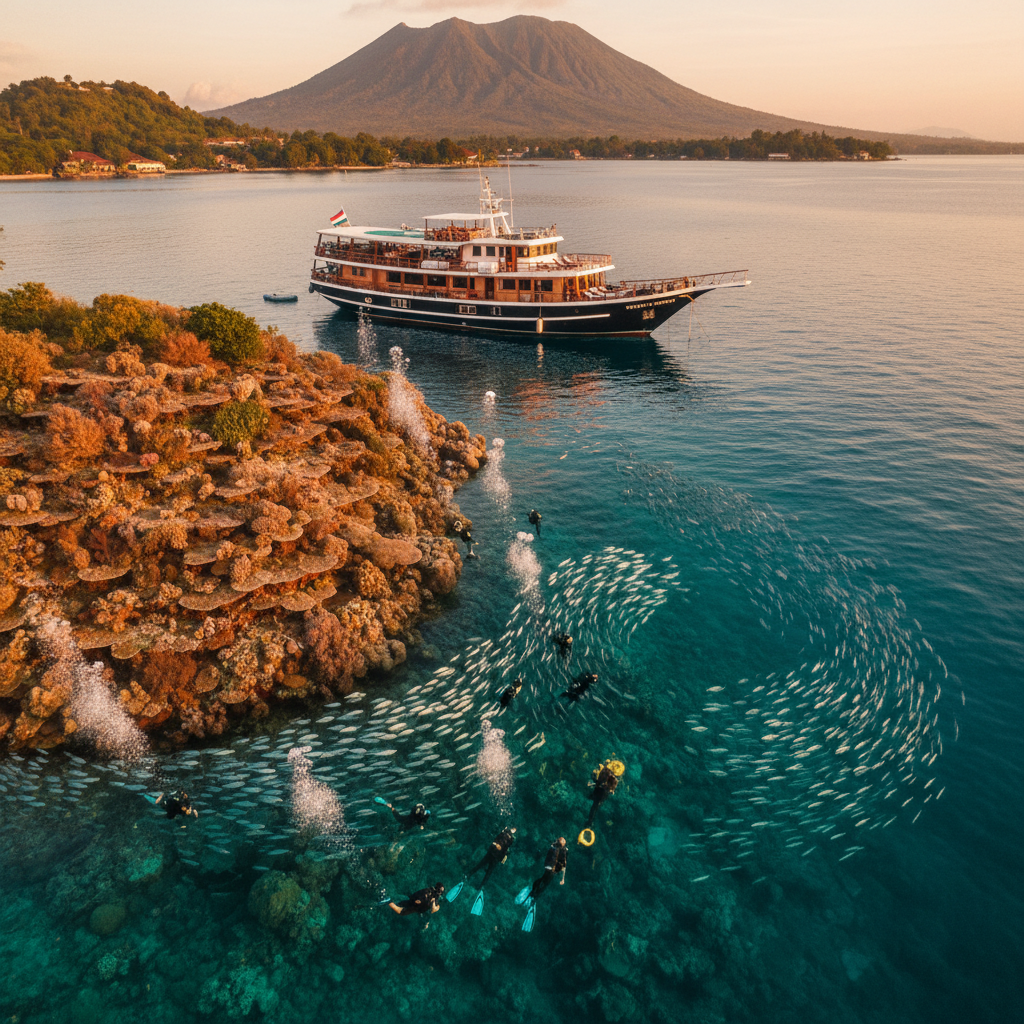
Located over 2,000 kilometers east of Jakarta, the Banda Sea guards one of the planet’s last truly wild marine frontiers. This is the heart of the historic Spice Islands, where the Dutch East India Company established a monopoly on nutmeg in 1621, and the world beneath the waves is even more intoxicating. For the discerning diver, a luxury expedition to the ten volcanic islands of Banda offers not just a holiday, but an immersion into a realm of staggering biodiversity and encounters with rare pelagic giants.
The Allure of the Banda Sea: Beyond the Surface
The Banda Sea’s legendary status is well earned. Its remoteness has protected it from mass tourism, preserving its reefs in a near-pristine state. Geographically, it sits at a critical confluence, where nutrient-rich waters from the Pacific and Indian Oceans mingle, drawn up from depths exceeding 7,400 meters in the Weber Deep. This upwelling creates an explosion of life, establishing the region as a critical hotspot within the Coral Triangle, an area harboring 76% of the world’s known coral species.
The result is an ecosystem of unparalleled richness, with underwater visibility often exceeding 30 meters. The volcanic foundations create a dramatic topography of sheer walls, submerged pinnacles, and black-sand slopes. Here, vibrant hard coral gardens thrive alongside immense sponges, providing a habitat for over 850 documented species of reef fish. But it is the sheer volume of marine life that truly defines the Banda Sea—a place where the big and the small coexist in spectacular abundance.
Prime Diving Seasons and Conditions
Timing is crucial for unlocking the best of the Banda Sea. The region is governed by monsoons, creating two distinct diving seasons. The first window is from March to April, when the seas are generally calm and visibility is excellent. This period is ideal for exploring the vibrant reefs around the central Banda Islands, with comfortable water temperatures averaging 27-29°C.
The second, more famous season runs from late September to early December, when water temperatures average a pleasant 27-29°C. While conditions can be variable, this is prime time for pelagic encounters. Plankton blooms attract larger marine life, including hammerhead sharks. A typical 10-night Ambon to Banda liveaboard is particularly rewarding during these months, offering the best platform to navigate the open-sea crossings and reach the most remote atolls in comfort and safety.
Signature Dive Sites: An Underwater Itinerary
While every dive in Banda reveals something new, at least a dozen sites have achieved legendary status. A well-planned luxury itinerary, often encompassing up to 30 dives over a 10-day trip, will invariably include these underwater landmarks. Curated by those with intimate local knowledge, each stop offers a unique window into the area’s diverse marine ecosystems.
The Lava Flow, Gunung Api
In 1988, the volcano of Gunung Api erupted, sending rivers of lava cascading into the sea. From this destruction, an astonishing new world was born. The Lava Flow dive site is a testament to nature’s resilience, now home to one of the fastest-growing coral reefs ever recorded. Divers can glide over vast, table-like acropora corals that have colonised the volcanic rock, creating a surreal, almost manicured underwater garden. The site is also known for its population of banded sea kraits, or Gunung Api sea snakes, which can often be seen hunting in the reef’s crevices.
Pulau Hatta and Pulau Ai
For those who appreciate dramatic underwater architecture, the outlying islands of Hatta and Ai are essential. These islands are fringed by striking drop-offs, with the famous Pulau Hatta coral walls plunging vertically to depths well beyond 60 meters. Drifting along these walls, divers are met with immense gorgonian fans and soft corals, while the currents attract larger species like dogtooth tuna, giant trevallies, and Napoleon wrasse that can exceed 1.5 meters in length.
Banda Neira Jetty
Not all of Banda’s treasures are found in the deep blue. Right in the main harbour, the Banda Neira Jetty offers a world-class muck dive at a shallow depth of just 5 to 15 meters. While the sandy bottom seems unremarkable, it hides rare critters like Ambon scorpionfish and ghost pipefish. It’s a macro photography paradise, and for a brief 30-minute window just after sunset, the site becomes the stage for one of nature’s most enchanting displays: the mandarin fish mating ritual.
The Legendary Hammerhead Migration
For many, the ultimate prize is an encounter with schooling hammerheads. During the autumn months, as water temperatures can drop to 26°C, the nutrient-rich currents attract large aggregations of scalloped hammerheads to remote sea mounts. It’s not uncommon for divers to witness schools of 50 to over 200 individuals on a single dive. This is the famed hammerhead migration, a spectacle that solidifies the Banda Sea’s place in diving folklore.
Witnessing dozens, sometimes hundreds, of these majestic predators cruising in silent formation in the deep blue is an experience that stays with a diver forever. These are not fleeting glimpses but profound encounters in the wild, open ocean. Reaching these specific locations requires expert navigation and timing, making a dedicated liveaboard the only feasible way to access this remarkable natural event.
Liveaboards: The Ultimate Banda Neira Luxury Experience
To truly appreciate the scale and diversity of the Banda Sea, a land-based stay is simply not enough. A liveaboard is the definitive way to explore this vast archipelago. The classic Ambon to Banda liveaboard route, or the reverse, allows for a comprehensive journey that includes the critter-rich bays of Ambon, the pristine reefs of the central Banda Islands, and the remote atolls where the hammerheads congregate.
The essence of a Banda Neira luxury experience is realised aboard these vessels. It is about more than just diving; it is about seamless logistics, expert guidance, and uncompromising comfort in one of the world’s most remote locations. Bandaneiraluxury adheres to a strict editorial standard, vetting and selecting only the finest phinisi schooners and expedition vessels that meet our criteria for safety, service, and environmental responsibility, ensuring your journey into this underwater world is as exceptional above the water as it is below.
Beyond the Dive: Conservation and Culture
Diving in the Banda Islands is an opportunity to connect with a place of immense historical and cultural significance. These were the original Spice Islands, the epicentre of the global nutmeg trade that shaped empires. A respect for this heritage is intrinsically linked to the preservation of its marine environment.
Responsible tourism plays a vital role in protecting this fragile ecosystem. By choosing operators who work with local communities and adhere to sustainable practices, visitors contribute directly to the conservation of this irreplaceable marine sanctuary. The experience is enriched by understanding that the health of the reefs and the prosperity of the Bandanese people are intertwined, a legacy as valuable as the spices that first brought the world to these shores.
Plan Your Banda Sea Expedition
The Banda Sea offers a journey back in time to an ocean teeming with life. Crafting the perfect expedition requires specialist knowledge and access to the region’s premier vessels. To begin designing your bespoke diving itinerary, please contact our specialists for a confidential consultation at bd@juaraholding.com or via WhatsApp at +62 811-3941-4563.
Frequently Asked Questions About Diving in the Banda Sea
What level of diving certification is required?
An Advanced Open Water certification with a minimum of 50 logged dives is strongly recommended. The diving often involves deep walls, strong currents, and open-ocean conditions, particularly at sites for pelagic encounters. Experience with drift diving and using a surface marker buoy (SMB) is essential for safety and enjoyment. Some liveaboards may require this as a prerequisite.
What is the average water temperature and what exposure suit do I need?
Water temperatures in the Banda Sea are consistently warm, typically ranging from 27°C to 29°C. However, some deeper sites or areas with upwellings can occasionally drop to 25-26°C. Most divers find a 3mm or 5mm full-length wetsuit to be perfectly comfortable for multiple dives a day. A hood or vest can be a useful addition for those who tend to get cold.
Is the Banda Sea suitable for non-divers?
While the primary focus is diving, non-divers can still have a remarkable experience. Luxury liveaboards offer comfortable lounging areas with spectacular views. Activities often include snorkelling on shallow reefs, kayaking, paddleboarding, and shore excursions to visit historic forts, traditional villages, and nutmeg plantations in the Banda Islands. The topside scenery is as dramatic as the underwater world.
What is the best time of year to see the schooling hammerheads?
The prime season for the hammerhead shark migration is from late September to early November. During this period, the convergence of currents and plankton blooms attracts large schools of scalloped hammerheads to the remote offshore pinnacles and atolls. While sightings are never guaranteed, this window offers the highest probability of witnessing this incredible natural spectacle.
Are there strong currents?
Yes, currents can be a significant factor in the Banda Sea, which is what makes the marine life so prolific. Dives are often planned as drift dives, allowing you to move with the current along a wall or reef. Dive guides are experts at reading the conditions. A reef hook can be a useful piece of equipment for certain sites, especially when waiting for pelagic action.
How do I get to the Banda Islands to start my trip?
Most Banda Sea liveaboard itineraries begin in Ambon (AMQ) or Maumere (MOF). Ambon’s Pattimura Airport is the most common gateway, with regular flights from major Indonesian hubs like Jakarta (CGK) and Makassar (UPG). Your chosen travel specialist will assist with the domestic flight logistics to ensure a seamless connection with your vessel’s departure schedule.
What can I expect to see besides big fish?
The Banda Sea is a paradise for macro photography and lovers of small critters. The biodiversity is immense. Beyond the pelagics, expect to see pristine hard and soft coral gardens, huge sponges, and a vast range of reef fish. Muck diving sites reveal rare creatures like the Ambon scorpionfish, ghost pipefish, flamboyant cuttlefish, and countless species of colourful nudibranchs.
Are night dives common on a Banda liveaboard?
Yes, night dives are a regular and highly recommended feature of a Banda Sea liveaboard trip. They offer a completely different perspective on the reef as nocturnal creatures emerge. It’s an excellent opportunity to witness the famous mandarin fish mating ritual at dusk, or to find hunters like moray eels and crustaceans on the move. The bioluminescence in the water can also be a magical experience.
What kind of vessel is best for exploring the Banda Sea?
A traditional Indonesian phinisi schooner offers the most authentic and luxurious experience. These handcrafted wooden vessels are built for stability and comfort, equipped with modern navigation, safety equipment, and dive facilities. Their spacious decks, comfortable cabins, and attentive crew provide an ideal platform for navigating the remote waters of the archipelago in style.
Are there any conservation or marine park fees?
Yes, divers are typically required to pay marine park and harbour fees. These funds are essential for supporting local conservation initiatives, patrols, and community programmes aimed at protecting the fragile marine ecosystem of the Banda Islands. The exact amount varies but will be clearly communicated by your tour operator as part of your trip package.
Related reading


