Updated: July 2026
The Golden Age of Spice: How Nutmeg Shaped the History of Banda Neira
Bandaneira Luxury is a curated Indonesia luxury tourism experience offered by Bandaneiraluxury Guide: handpicked routes, vetted operators, transparent pricing, and 24/7 concierge support across Indonesia.
- What makes Bandaneira Luxury a premium experience.
- How Bandaneiraluxury Guide curates exclusive access and concierge logistics.
- Routes, seasons, and pricing transparency — no hidden fees.
The Golden Age of Spice: How Nutmeg Shaped the History of Banda Neira
Long before the world craved gold or oil, it was a fragrant seed from a remote Indonesian archipelago, located over 12,000 kilometers from Amsterdam, that dictated the fortunes of empires. The allure of modern Banda Neira luxury is inseparable from this dramatic past, a history forged in the perfumed aroma of nutmeg. To understand these serene islands is to understand a global story where a single spice, which by the late 16th century could increase its value 60,000-fold on its journey to Europe, held the power to finance wars and redraw the map of the world.
The World’s Sole Source of Nutmeg
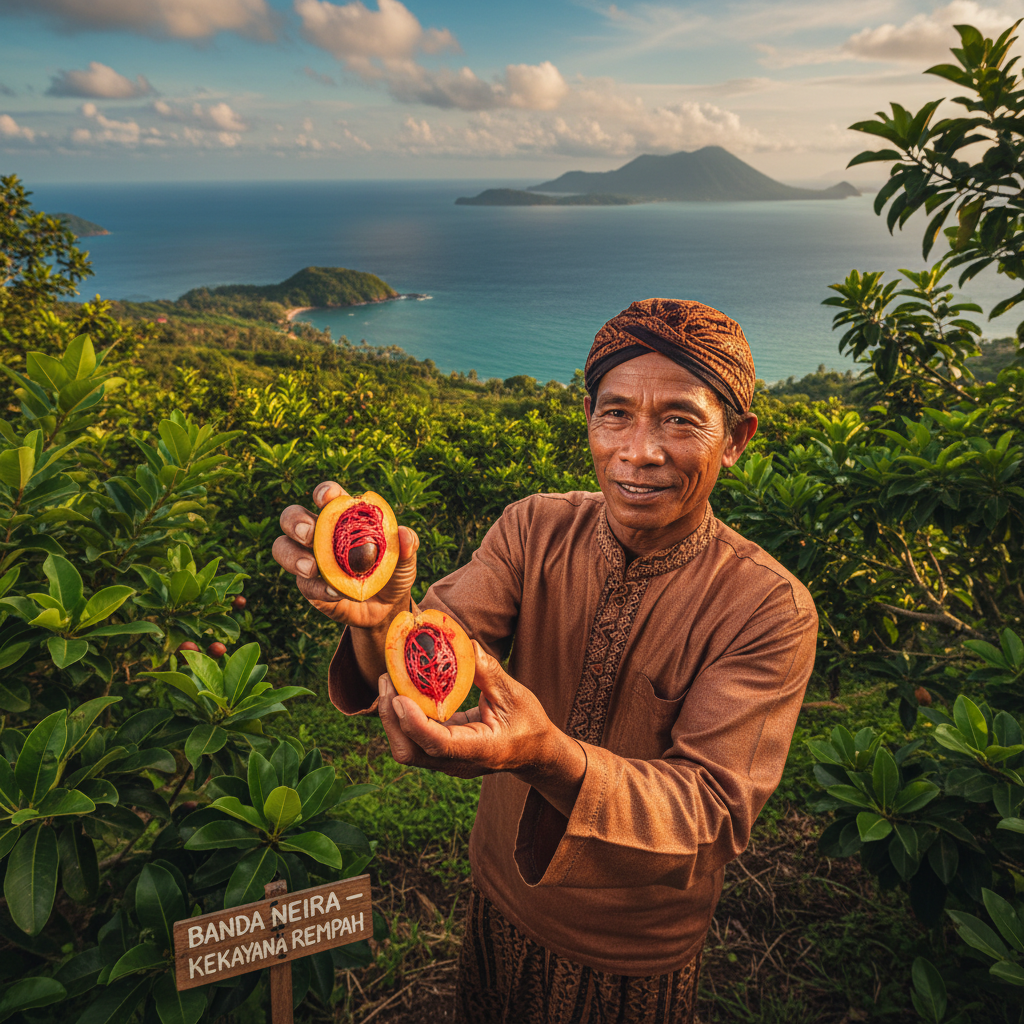
For centuries, the Banda Islands were a geographical anomaly of immense value. This tiny cluster of eleven volcanic isles in the Maluku Sea was the only place on Earth where the nutmeg tree, Myristica fragrans, grew. The fruit’s seed, nutmeg, and its lacy crimson covering, mace, were among the most coveted commodities in the early modern world. Believed to ward off the plague and prized for its culinary properties, its value in 14th-century Germany was such that a pound of nutmeg could be traded for seven fattened oxen.
Before the first European ships breached the horizon around 1512, the Bandanese people were masters of their own destiny, participating in a sophisticated trade network that had existed for over a thousand years. Their nutmeg was exchanged with Javanese, Malay, and Arab merchants who sailed the monsoon winds on voyages that could take up to six months, carrying the precious spice along ancient routes to India, the Persian Gulf, and eventually, via Venetian merchants, to the wealthy households of Europe. It was a lucrative but balanced trade, one that would be irrevocably shattered by the arrival of those seeking not to trade, but to conquer.
The Arrival of the Europeans: VOC and the Spice Monopoly
The Portuguese were the first to arrive in 1512, but it was the Dutch, under the banner of the formidable Dutch East India Company (VOC), founded in 1602, who would leave the deepest and most brutal scar on the islands. The VOC’s objective was not partnership but total monopoly, a goal they formally established with the capture of Fort Nassau in 1609. They sought to control the source of the nutmeg trade with an iron fist, and they were willing to pay any price in blood to achieve it.
This quest for control culminated in the tragic events of 1621. Under the command of the ruthless Jan Pieterszoon Coen, the VOC systematically depopulated the islands with a force of nearly 2,000 soldiers. The Banda Massacre saw the execution, enslavement, or exile of almost the entire indigenous population, which was estimated to be around 15,000 people. It was a calculated act of genocide designed to wipe the slate clean, allowing the Dutch to seize the land and impose a new order built entirely around the profitable cultivation of nutmeg.
Fort Belgica and the Architecture of Control
The physical manifestation of this new order still dominates the skyline of Banda Neira today. High on a hill 30 meters above the main town and its perfect harbour stands Fort Belgica, a formidable pentagonal fortress rebuilt by the Dutch in 1611. It was not merely a defensive structure; it was a statement of power, a constant and intimidating reminder of who was in control. Its cannons, now silent, once pointed not only out to sea to deter rival European powers but also inland, towards the very plantations they were built to police.
From its restored battlements, the strategic genius of its location is clear. One can survey the entire channel, the neighbouring island of Banda Besar just 1.5 kilometers away, and the majestic, ever-present cone of the 658-meter Gunung Api volcano. Alongside the smaller Fort Nassau at the water’s edge, these structures formed a network of military control that ensured every single nutmeg harvested would pass through Dutch hands. Visiting them today is a powerful, tangible connection to the islands’ turbulent history.
The Perkenier System: A Plantation Society is Born
With the local population eliminated, the VOC implemented the perkenier system. They divided the most fertile land on the islands into a series of 68 plantation plots, or perken, which were granted to Dutch planters (perkeniers). These men, often former VOC soldiers, were tasked with cultivating nutmeg using enslaved labour brought from as far away as Java, Bali, and even the coast of India. This created a colonial plantation society, a thin layer of European wealth built upon a foundation of immense human suffering.
The immense profits generated by the spice monopoly funded the construction of grand colonial mansions, with their distinct European architecture adapted for the tropics. These sprawling homes, with their large verandas and high ceilings, lined the waterfront of Neira town. Today, many of these historical buildings remain, some beautifully restored as boutique accommodations, offering a glimpse into the opulent and troubled world of the *perkeniers*. They are a core part of the Banda Neira luxury heritage experience, allowing visitors to inhabit the very spaces where history was made.
Echoes of the Past: Experiencing Banda Neira’s Heritage Today
To journey through Banda Neira today is to walk through a living museum. The scent of nutmeg and cloves still hangs in the air of the shaded *kebun pala*, or spice gardens, where the harvesting process has changed little in centuries. The quiet lanes of Neira town are flanked by the ghosts of the colonial era, from crumbling Dutch manors to the old governor’s palace. The complex cultural fabric is a blend of indigenous, European, Chinese, and Arab influences, a direct legacy of its history as a global crossroads.
Engaging with this past is the essence of a true Banda Neira luxury journey. It is about more than just beautiful scenery and world-class diving; it is about understanding the profound story etched into the landscape. Our editorial team insists that every itinerary we endorse is curated with deep respect for this history, partnering with local guides whose knowledge has been passed down through generations, ensuring an experience that is both enlightening and authentic.
Plan Your Historical Journey
The golden age of spice may be over, but its legacy endures, offering a travel experience of unparalleled depth and beauty. To explore the intricate heritage of the Spice Islands with guidance grounded in authentic local expertise and a commitment to responsible tourism, we invite you to begin a conversation with our specialists. Contact our team at bd@juaraholding.com or via WhatsApp on +62 811-3941-4563 to begin crafting your bespoke journey into history.
Frequently Asked Questions About Banda Neira’s History and Travel
What is the historical significance of nutmeg in Banda Neira?
For centuries, the Banda Islands were the world’s only source of nutmeg and mace. These spices were more valuable than gold in medieval Europe, driving global exploration and trade. This monopoly led to intense conflict, culminating in the Dutch VOC’s brutal conquest in the 17th century. The islands’ entire history, from their wealth and colonial architecture to their tragic depopulation, is a direct result of this small, fragrant seed. It literally shaped the destiny of the islands and influenced global economic history.
Is it safe to travel to the Banda Islands?
Yes, the Banda Islands are considered a very safe destination for travellers. The period of civil unrest in Maluku ended two decades ago, and the islands have enjoyed peace and stability since. The local community is exceptionally welcoming to visitors. As with any remote travel, standard precautions are advised, but crime rates are very low. The primary challenges are logistical, related to transport, rather than personal safety, making it a serene and secure place to explore.
What is the best time of year to visit Banda Neira?
The ideal time to visit Banda Neira is during the dry season, which typically runs from September to December and again from March to May. During these months, the seas are calmest, visibility for diving and snorkelling is at its peak, and weather conditions are most favourable for island hopping and exploration. The shoulder months can also be excellent, often with fewer visitors. The wet season, around June to August, can bring rougher seas and more rain, potentially disrupting ferry and flight schedules.
How do I get to Banda Neira?
Reaching Banda Neira is part of the adventure. The most common route is to fly to Ambon, the provincial capital of Maluku. From Ambon, you can either take a small propeller plane (subject to weather and operational changes) or a fast ferry. The ferry is the more reliable option, though the journey takes several hours. Planning travel with a degree of flexibility is essential, as schedules can change. A well-organised trip will account for these potential delays, ensuring a smooth experience.
What are the main historical sites to see?
The key historical sites are concentrated in and around Neira town. Fort Belgica, the magnificently restored pentagonal fortress, is a recommended, offering panoramic views. Below it lies Fort Nassau, the first Dutch fort. The historic town itself is full of colonial-era mansions, a Dutch church, and the former governor’s palace. You can also visit the house where Indonesian founding father Mohammad Hatta was exiled. On Banda Besar, you can explore old nutmeg plantations (*perken*) and see traditional cultivation methods.
Can I visit a working nutmeg plantation?
Absolutely. Visiting a *kebun pala*, or nutmeg garden, is a highlight of any trip to Banda. You can walk beneath the vast, shady kenari trees that protect the delicate nutmeg trees below. Local guides can explain the entire process, from how the fruit is harvested with a special bamboo tool to the separation of nutmeg and mace, and the lengthy drying process. It is a fascinating sensory experience that directly connects you to the islands’ historical and economic heart.
What kind of luxury accommodation is available in Banda Neira?
Luxury in Banda Neira is defined by heritage, authenticity, and exclusivity rather than large-scale resorts. The premier accommodations are beautifully restored colonial-era mansions and plantation houses that have been converted into boutique hotels or guesthouses. These properties offer immense character, historical significance, and personalised service. They provide a comfortable and atmospheric base from which to explore the islands, combining modern amenities with the profound charm of a bygone era. Our team vets properties for quality, service, and historical integrity.
Besides history, what other activities are popular?
Banda Neira is a world-class destination for diving and snorkelling. The surrounding waters are part of a marine protected area, boasting pristine coral reefs, incredible biodiversity, and dramatic underwater topography, including volcanic sea mounts. Encounters with large pelagic species are common. Other popular activities include hiking the Gunung Api volcano for a spectacular sunrise view, island-hopping to secluded beaches on Pulau Ai or Run, and simply enjoying the tranquil pace of island life.
What was the VOC?
The VOC (Vereenigde Oost-Indische Compagnie), or Dutch East India Company, was a powerful multinational corporation founded in 1602. It was granted a state-backed monopoly on all Dutch trade in Asia. With its own ships, soldiers, and administrative powers, it functioned like a state-within-a-state. The VOC’s primary goal was to dominate the lucrative spice trade, and it used extreme violence, including the Banda Massacre of 1621, to secure its monopoly on nutmeg, cloves, and mace, profoundly shaping Indonesian history.
Who were the perkeniers?
The *perkeniers* were the Dutch planters who were granted plots of land (*perken*) on the Banda Islands by the VOC after the indigenous population was decimated in 1621. These men, often former VOC employees, were tasked with cultivating nutmeg using enslaved labour. They became a wealthy colonial elite, building the grand mansions that still characterise Neira town. They were obligated to sell all their nutmeg and mace to the VOC at a fixed, low price, ensuring the company reaped the vast majority of the profits.
Is English widely spoken in Banda Neira?
In tourist-facing establishments such as hotels, dive centres, and with registered guides, English is commonly spoken. However, outside of these areas, the primary language is a local dialect of Malay (Bahasa Ambonese). While you can certainly navigate the main areas with English, learning a few basic phrases in Bahasa Indonesia, such as ‘terima kasih’ (thank you), is greatly appreciated by the local community and will enrich your interactions. A good guide is invaluable for deeper cultural conversations.
What is the local currency and are credit cards accepted?
The local currency is the Indonesian Rupiah (IDR). It is essential to bring a sufficient amount of cash with you, as credit card acceptance is extremely limited on the islands. While your primary hotel may accept cards, most local restaurants, shops, and services operate on a cash-only basis. There are a few ATMs in Neira town, but their reliability can be inconsistent. It is highly recommended to withdraw or exchange money in a larger city like Ambon before arriving in Banda Neira.
Related reading